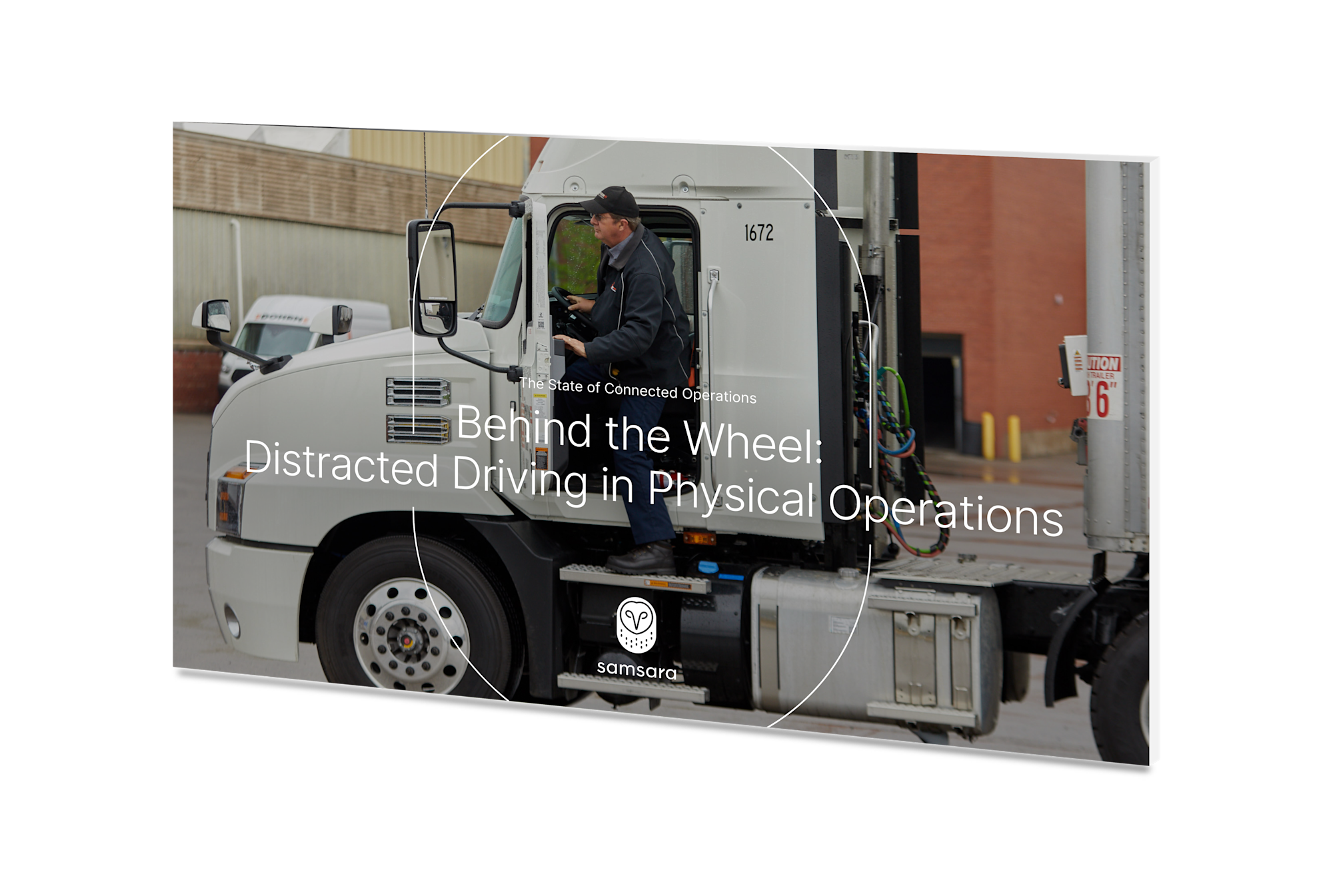
New Report
Behind the Wheel:
Distracted Driving in Physical Operations
Download the latest State of Connected Operations Report to see what drivers themselves say are their biggest
distracted driving challenges, while also highlighting their top strategies and solutions.
We surveyed 1500+ commercial drivers with 14.7K+ years combined driving experience in 21 industries across 7 countries.
Executive summary
Distracted driving is a top challenge, but drivers see technology, training, and policies as keys to improvement.
Discover the solutions drivers say are making the biggest impact—and how organizations can reduce risk, enhance driver safety, and keep the roads safer for everyone.


PRIORITIZING SAFETY ON THE ROAD
A split second can change everything–93% of drivers have personally felt the impact of distracted driving.
Distracted driving is a challenge for many commercial drivers, regardless of age or experience. 76% report they are often distracted by their personal mobile devices while driving–highlighting a powerful opportunity for change.
Download ReportTOP DISTRACTIONS COMMERCIAL DRIVERS ARE FACING
32%
Using personal phone to read/send messages
30%
Smoking/lighting a cigarette, e-cigarette, or vape
29%
Talking on a handheld phone or hands-free device
29%
Using personal phone to check social media
28%
Eating or drinking
Injuries, vehicle damage, and suspensions—a harsh reality of distracted driving nearly all drivers have felt firsthand.
93% of drivers have personally experienced the impact of distracted driving. From vehicle damage and personal injury to fines and license suspensions, these consequences reinforce the need for proactive solutions that both protects drivers and reduces preventable risks on the road.
Mobile devices are essential for work-related tasks on the road—but how can drivers stay both connected and safe?
With 74% of drivers reporting that they use a mobile phone or other technology for work-related tasks while on the road, drivers say employers can help them reduce this risk. Their top asks are for improved communication systems to limit work-related calls/messages (44%) and better in-cab routing (43%).
Mexico and France report highest rates of personal mobile device distraction.
Drivers in Mexico (83%), France (79%), and the U.S. (77%) report the highest levels of mobile distraction while driving. Knowing the causes helps organizations to invest in fleet management technologies and training that will help their drivers stay focused and safe on the road.
EFFECTIVE STRATEGIES TO REDUCE DISTRACTED DRIVING
Organizations that invest in safety technology and training are benefitting from stronger driver retention.
Drivers overwhelmingly prefer to work for companies that prioritize their safety and take proactive steps to prevent distracted driving, with 90% likely to stay with an employer that implements these measures.
Download ReportHOW DRIVERS ARE CURRENTLY BEING COACHED OR TRAINED ON DISTRACTED DRIVING
Digital coaching or training
In-person coaching or training
In-cab coaching (by alerts)
Not receiving coaching or training
Organizations are investing in proactive coaching to reduce distracted driving.
95% of drivers are receiving coaching or training on distracted driving–and nearly all say it's improved their driving habits. Digital coaching (64%) is the most widely used method, reinforcing safety through consistent and scalable training.
Dash cam footage is a powerful tool in helping drivers recognize and address their own distractions.
93% of drivers agree that seeing dash cam footage of themselves has increased their awareness of being distracted while driving. After seeing their dash cam footage, 60% of drivers changed their driving habits.
Drivers see onboard safety systems as an asset.
65% of drivers trust onboard systems that monitor for distracted driving and alert them when an incident occurs, helping them stay focused. Strong driver buy-in reinforces their effectiveness in reducing distractions and improving overall road safety.
SHAPING THE FUTURE OF SAFE DRIVING
Looking ahead, drivers want AI, stronger policies, and incentives to help keep the road safe.
AI-powered detection with accurate alerts is the top safety technology drivers want to help mitigate the risks of distracted driving. Drivers say strong safety programs, technology-driven solutions, and clear policies will also help them stay focused and safe on the road.
Download ReportDrivers want AI-powered solutions to help them stay focused and safe behind the wheel.
AI-powered detection with more accurate alerts is the #1 safety technology drivers want to help them with distractions. Drivers also identified improved hands-free communication systems (50%) and a dedicated dash cam record button to capture additional context during incidents (48%) as other key technologies they wish were available to mitigate distractions while driving.
Organizations are seeing success in their efforts to reduce distracted driving.
Drivers have confidence in their company’s distracted driving policies, with 82% of drivers believing their company’s current policies are effective. The top policies drivers identified for reducing distractions included mandatory driver training, penalties for mobile device use, and public awareness campaigns.
Drivers weigh in on the future of road safety regulations.
When asked what future regulatory changes would make the biggest impact on safety, drivers pointed to several key areas. Increased fines or penalties for distracted driving (50%) topped the list, followed closely by requiring in-vehicle safety features like in-cab alerts (49%). Stricter rest requirements (47%) and more frequent roadside inspections (45%) were also seen as potentially effective measures.
WHICH DISTRACTED DRIVING POLICIES AND INITIATIVES DO DRIVERS FIND MOST EFFECTIVE?
What do commercial drivers have to say about road safety?


Want to reduce distracted driving? Hear from drivers themselves.
Download the full report today to uncover firsthand insights from drivers on the biggest challenges of distracted driving—plus the strategies and technologies they say are making the greatest impact.
Download Report